Community Engagement- Waddington (2 May 2017)

These past two weeks we have been beginning our community engagement in Waddington. Artist Simon Grennan and I have been visiting local community groups and schools, holding both art workshops and general introductions, which may result in meeting people who would take part in our oral history programme. We started by visiting Waddinton pre-school last week, and working with the young children getting them to draw their favourite place. This information will be combined with other residents’ significant places in Waddington which will influence Simon’s ideas for his permanent artwork, which will be made at the end of the year. The pictures that were made by the children will be put on display at our main event, which is taking place on the 24th June.

After pre-school, Simon and I went to the coffee morning, taking place in the Waddington Community Hub. We talked to many residents, many of whom had lived in the village for over 60 years. We asked them for their significant places and in return heard many stories of life in Waddington that helps to build an impression of the village which Simon will then portray in his later works. We heard a great story from a woman named Irene who moved here to Waddington to marry her boyfriend stationed at the RAF base:

She lived in Kent until she was in late teens, and met her now husband from the RAF. Her husband was stationed back to Waddington and lived with his parents again in their RAF hut near the village hall. When Irene moved up there to get married, she hadn’t been out of Kent before so didn’t know what to expect and was put off when her husband said that his mums house had 13 rooms. She was worrying how to behave when she got up there, and recalled many conversations with her best friend about how she was going to use all the different types of cutlery. When she arrived at the wooden RAF shack she realised that some of the rooms were basically cupboards. She recalled her first meal there eating a yorkshire pudding swimming in gravy, while sitting outside with their plates resting on a card table; she was so happy she wasn’t marrying into wealth, but was almost sick from the disgusting food!

This week, we held some art workshops in the two schools of Waddington: All Saints and Redwood. We gave the pupils two exercises; first they had to draw their significant place, and then draw a character that represents Waddington for them. We had a wide range of answers to this second question revealing the glorious eccentricity and imagination of the childrens’ minds. Many took the question literally and drew a creature with houses for limbs, others used physical features of the village to clothe the character, like using roof tiles for fish-like scales and locally grown wheat for hair. It was a very rewarding experience and the exercise was useful for the children to challenge them to imagine a personification of their home. Here are a few examples:

Winter Haecca (18 December 2016)

This week was the week of the Winter Haecca, the main event of the second section of the Ridges & Furrows Project based in North Hykeham. The night before the event I loaded up a hired van with the ceramic lights, NKarts gazebo, pop up banners and Ridges & Furrows flags. I was very excited for the event as I had been involved from the very start; compared to the Welbourn Horkey when I was brought in a month into preparations. I was very interested also to see if the event would work as well in the dark. We had to come up with a different form of evaluation as we couldn’t give out surveys due to the light. We printed some postcards that had three questions on them, and to ensure we got a good amount of feedback, we gave away free glowsticks for every completed postcard that was handed back. The postcards were a beautifully designed set of four; each set were printed with either an earth, wind, fire or water design on the front (in the Ridges & Furrows style), and on the back was a corresponding fact about each theme’s connection with North Hykeham’s history.

On the morning of the event, myself and project historian Dave Reeves went to Lincoln to appear on BBC Radio Lincolnshire to publicise the Winter Haecca. Dave talked about the name Haecca, the town’s history and the event’s attractions. I had taken my accordion in and played Jo Freya’s processional tune. Interview starts at 02.11:40, my rendition of the processional tune can be heard at 02.18:45. Here is the link:

http://www.bbc.co.uk/programmes/p04hvz0z

On my return, the team had arrived with the loaded van; like the Horkey, many members of the NKarts partnership showed up to volunteer giving the event a nice feel of communal effort and we all shared in the magic of it. As the early dusk fell, we set about putting ceramic lanterns (that had been created for a previous project) around trees near a back entrance to the village green which created a fairy-circle effect and gave more colour to the dark, cold night.

15440431_1999908220236118_3923746557532611369_o

A close up of the ceramic lanterns used to light up the Haecca

The town council’s part was coming together also, a big stage had been erected which was to accommodate the nativity play and the North Hykeham song performance. The Christmas stalls were also beginning to arrive and added noises and entrancing smells to the event. Half an hour before the scheduled start, the children from schools and the community workshops started to arrive and pick up their lanterns ready to process. Dave, Crauford and myself had a quick practice of the processional tune and awaited our marching order. The sun had gone down completely by the time we set off around the site, and the lanterns really stuck out against the night sky creating a beautiful effect. We led the star-lit cavalcade past the main stage, past our aerial performance area, through the stalls and over the little beck at the back of the green. We placed the lanterns into the ground at the far side of the beck so people on the main site could see the lanterns still shining across the water.


After the procession, our aerial volunteers started their performance. Our dance team had been running workshops in Boston for months and the volunteers really rose to the occasion. The blue and white lighting, twinned with ambient music and smoke bombs created a beautiful atmosphere in which the dancers looked graceful and professional on the silks. It drew a huge crowd which gave great feedback. The performance was a beautiful addition to the evening and something that was a welcome surprise to the entranced onlookers.


After the Town Council’s nativity play and children’s Christmas songs, Crauford and I took to the stage to direct the North Hykeham Song written by artist Jo Freya. The school children and the High Notes choir performed very well and the stage, packed with people, created a beautiful noise that carried far into the town.

15591265_1999908150236125_4822758932987591174_o

Members of the High Notes Choir perform the North Hykeham Song


The amazing aerial dancers gave the crowd another performance and people gradually dispersed over the next half an hour. It was a beautiful event, the bright lanterns, artworks, dance displays and the community’s singing filled the winter night with warmth and delight. The Haecca had a very different feel to the Horkey, it was all taking place on the green, compared to the many venues in Welbourn. The effort that both artsNK and the Town Council went to to make the event light and festive surpassed the Horkey as the green was lovely to look at. While being less historically informative than the Horkey, due to the light not be accommodating to setting up information boards, we hoped that due to the facts on the feedback postcards and the history woven into the art the Ridges & Furrows artists and the community created, the people of North Hykeham learnt a little more about their local heritage.

Winter Haecca: Final Lantern Making Workshop (11 December 2016)

This week was a very full week as it was the week before the Haecca on the 14th December. This week saw the finishing of the big banners that were to go on the side of the village green where the event was taking place. More final preparations were underway too, Jo Freya had her last rehearsal with the local choir, the High Notes. I also was very busy at the start of the week having long walks around the town giving leaflets to any business, person and pin board that would take them. We also had a rehearsal of the procession tune Jo had written, mid week. I was to play again, also project historian Dave Reeves and the musical co-ordinator for the event Crauford Thomson joined me to have a run through. We were made up of an accordion, melodeon and a mandolin. The procession would sound, as well as look, beautiful.

This week contained the final community workshop for the lantern making. We had a great turn out again, more than 30 people filled the Terry O’Toole theatre and used the stencils, created in the previous workshop, to make some brilliant paper lanterns. The peas I got in Spalding were also used to make shakers that were decorated in the colours of the earth, wind, fire and water theme for the North Hykeham section of the project. The procession would look amazing, fingers crossed for a dry night!


Haecca Publicity and School Workshops (4 December 2016)

The leaflets for the Winter Haecca event arrived today, they followed the same design pattern as the Horkey posters and leaflets with similar colours to keep a sense of continuity. (See below) Distributing them was now a priority with the event on the 14th looming down on us. I therefore booked a time at the big ASDA in North Hykeham to do some leaflet distribution in the lobby. As the Haecca would be a very varied event, incorporating interpretive dance, community artworks, social history and the Town Council’s input of Christmas stalls, songs and plays, I had trouble deciding which opening line to use to get people’s attention. I therefore settled on a rather crude option of deciding which people may like certain things. For families with young children I started with ‘Would you be interested in coming to a Christmas Fair?’, with older residents I chose social history as an opening line, etc. The best response I had was from an old boy from North Hykeham who, when asked ‘are you interested in local history?’, replied ‘I am local history mate’.


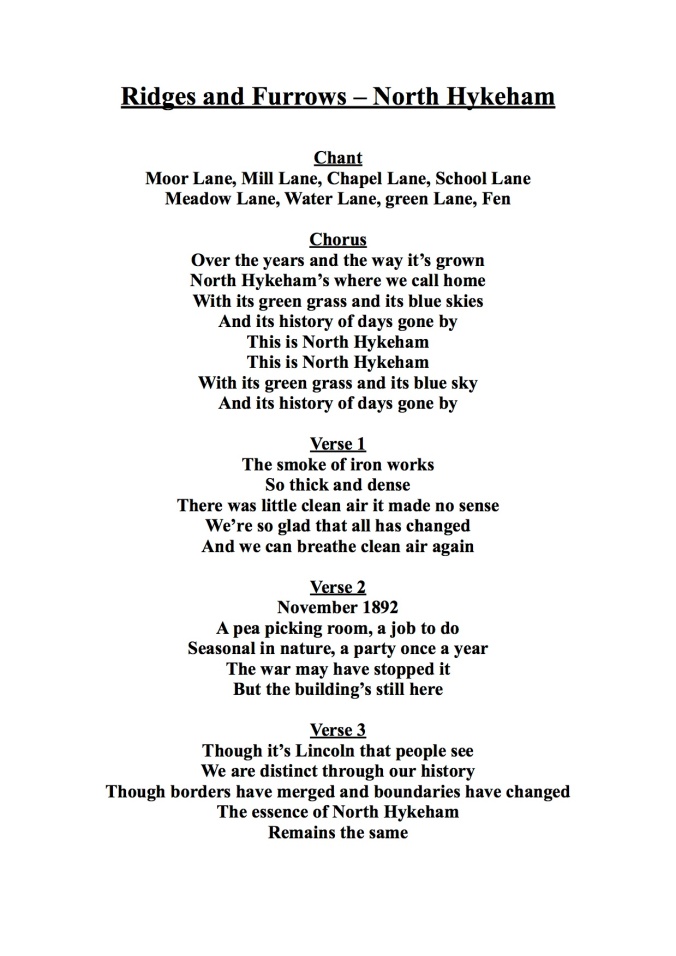
Later on in the week we received word from artist Jo Freya that she had finished most of the verses for the North Hykeham song she was writing for the event and teaching to children in local schools. It starts with an opening chant with the town’s oldest streets, then breaks into the main body of the song, influenced by the 50s rock and roll style.

song-for-blog

North Hykeham Song composed by Jo Freya.


In addition to the lantern making workshops and Jo’s music workshops in local schools, we were also providing two days of history workshops at South Hykeham Community Primary School. I went for both days with project historian Dave Reeves. We used some similar topics as in the workshops Dave did in Welbourn Primary school, such as the old occupations of the area, their parents’ occupations and their own ‘marks’ incorporating the jobs they wanted to have. In addition, as we had the maps I had sourced from the town council, we described how the occupations in North Hykeham had changed over the years. At the end of each workshop we showed the children the maps and invited them to find the old windmills, the foundry, the old gravel pits and, yes, their own homes. Dave and I had a great time teaching the children and involving them in such ways as to get them excited about their local history.

Below are some of the occupational ‘marks’ the children created.

North Hykeham Lantern Workshop (29 October 2016)

After the Welbourn Horkey, this week afforded everyone a bit of a rest from the hectic organisation of the event. My monday involved a leisurely drive to the storage facility to drop off lots of the equipment used for the event such as stakes, signs, workshop materials and the Ridges & Furrows banners. I collected the feedback forms from the artsNK offices at the National Centre for Craft & Design and had a flick through: there was lots of great feedback and the main point of good feedback was the freshly pressed, local apple juice! Also a few expressed their fondness for the music which was nice to hear.

After that, I took a few deserved days off. However the project in North Hykeham was already underway with a lantern making workshop taking place in the Terry O’Toole Theatre, which was our base of operations for this section of the project. I helped set up the tables and equipment with the two artists for this section of the project Ruth Pigott and Nadya Monfrioli. The workshop was the first of two, this first one designed for people of all ages to create stencils of local heritage inspired designs, cut out of card, which would then form silhouettes on the lanterns. It was very well attended and people seemed to have a great time. The quality of the designs, was a good sign that the North Hykeham section of of the project would yield just as beautiful and creative artworks as in Welbourn. The North Hykeham event was going to be in the evening so the personalised Hykeham lanterns would shine against the cold winter sky! Here are a selection of the stencils made in the workshop:

The Welbourn Horkey (23 October 2016)

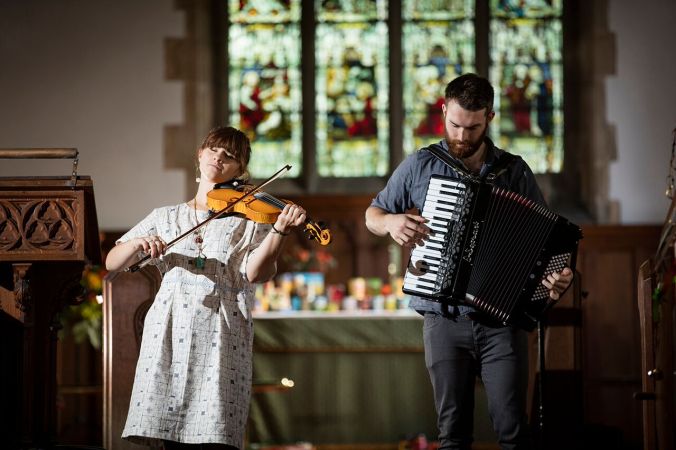
The day had finally arrived, my first large event working in arts administration, or indeed working at all! We arrived at the site around 8am and with bleary eyes we went about making last minute arrangements. Myself and project historian Dave Reeves went around the village putting up signs directing visitors, and displaying info on certain historical sites such as the old co-op shop and the forge. When people started arriving, myself and my musical duo partner Rosie Butler-Hall played music at our assigned spots at the church and village hall. We capitalised on the professional photographer being there by getting him to take some good publicity pictures of us!


unspecified-8

Danny Pedler & Rosie Butler-Hall playing in St. Chad’s

The visitors all seemed happy, well fed and watered; there was a hog roast that I’d organised, villagers selling cakes in the village hall and free apple juice, pressed that morning from apples from the community orchard. People had lots to see but also lots to do, Lyndall and Miranda were holding workshops throughout the day, adding to the artwork which the other workshops had produced. The co-op shop was slowly getting fuller.

welbourn-horkey-174

The old co-op set

More attractions opened throughout the day with the farmers’ exhibitions on the green getting going with the 1920s threshing machine they had brought being fired up and hay bales being produced by it.

welbourn-horkey-276

The 1920s threshing machine demonstration

In addition, two young volunteers opened the forge, fired it up and worked some metal on it. Dave was down there explaining about the history of it to the onlookers also.

welbourn-horkey-282

A volunteer working the bellows at the old forge

It was a great day, it was so rewarding to see exhibited, the creative efforts of people of all age groups who had themselves been inspired by their local history. It was a brilliant, educational event to be involved with and so fun to organise. However, a revelation that hit me on the day is the amount of feedback we were required to collect. As a public funded project, through the Heritage Lottery Fund, we had to accurately report the day to them and how it met their requirements. In addition, evaluation is needed to secure funding for future projects and also to reassure funders that they did invest well, especially in an age where funding is being cut all over the arts sector. I was put to work, in my free minutes when I was not playing, handing out surveys for people to fill in. Not the most enjoyable thing on the day, but very important, and a very good insight into the behind-the-scenes work which makes the valuable community work arts administration does possible!

Community Workshops (8 October 2016)

My second week as an intern for the Ridges & Furrows project started off with painting posters promoting the community art workshops run by our resident artists. It marked a nice turn of pace from the frantic first week as I was able to do it in my living room. It was also a big role reversal in our house as I was doing arts and crafts and my girlfriend, who had previously done a textile degree, was reading history! I then had to go out and collect some A-boards from one of our contacts in the village and put them up in the entrances and exits to the village.

The first workshop was led by jeweller Miranda Sharpe; she taught all the attendees how to do enamelling. It was aimed at an adult audience and involved use of a small portable kiln. It was great to see the themes from the historical research used in such imaginative ways to make patterns on the metal. Here are some examples of what was made:


The second workshop was a family workshop led by artist Lyndall Phelps which aimed to create a stage-like set of the old Co-operative shop which used to run in the village. The Welbourn branch was the first rural branch of the Co-operative family and opened in the 1840s. The workshop saw a great attendance with families staying for the whole day to create whole hampers of artwork.


During this week I met all the local volunteers involved in the steering group meeting for Welbourn; the meeting brought together the project leads from artsNK, the historian, artists and numerous locals from the village. With representatives from the parish council, primary and secondary schools and farming community volunteering to help at every stage of the project it really felt like a project in the best interests of the community. All this work was building up to a community-led, one day festival in which the artwork created by the village would be exhibited. This was later called the ‘Welbourn Horkey’, the name taken from the end of harvest feast the farmer would provide for his workers who helped. While seeming an generous, communal gesture, this feast was held instead of payment; a practice which soon died out with the more capitalist arrangement of landlord paying peasant, which arose in the sixteenth century. I revelled in learning this information and was getting on very well with the Ridges & Furrows historian Dave Reeves. It has been a joy for me to carry on learning and researching history after the end of my degree to keep my brain working in the same way and keep certain skills honed.

Ridges & Furrows (1 October 2016)

Hello, my name is Danny Pedler and welcome to a blog about my first job out of university; an internship in the artsNK project, Ridges & Furrows! The project works to introduce artwork to communities in three target locations in Lincolnshire. In each location, the project researches their local, social history then, through working with both the community and professional artists, create artworks inspired from the historical research. This blog will reveal what it is like working for artsNK through my personal journey with the Ridges & Furrows project. I hope to better illustrate what it is like working in an arts administration organisation, and what the Ridges & Furrows project is trying to achieve. Enjoy!


In June, I graduated from Goldsmiths College, University of London with a 2:1 in History of Ideas; it was a relatively pretentious degree that was incredibly fun to study, but that I thought wouldn’t yield much in the way of a career. While looking for work across all disciplines, I applied for the role of ‘Freelance Historian’ for the Ridges & Furrows project. Despite being turned down from this job due to lack of experience, I was offered an internship, as the artsNK staff were often lacking someone on the ground to carry out a wide range of tasks. I remember getting the call in the middle of Morrisons and doing a mini fist pump. I moved from Essex to Lincoln and began an exciting, unrestricted job full of diverse assignments.


I had a very good first week to introduce me to the work that artsNK does. I first had an induction with the team who are based at the National Centre for Craft & Design in Sleaford. It was pretty confusing getting my head around the bureaucratic machinery of the organisation, and was told by my rather stressed inductor about the laborious task of correctly budgeting the Heritage Lottery funding for the project. After this introduction I was set to work helping in some art workshops that had already been organised in the first target village of the project which was Welbourn, just south of Lincoln. It is a beautiful community with a great agricultural heritage which became clearer as we delved deeper into the history of the village. This first section of the project employed two artists, with whom I worked with straight away, called Lyndall Phelps and Miranda Sharpe.

Their work can be seen here:


http://www.lyndallphelps.com,    http://www.mirandasharpe.co.uk


This stage of the project worked closely with the village primary school teaching workshops for their art week which included paint activities by Lyndall and metalwork with Miranda, all based on the research into the village’s history that had already taken place. I also helped the project’s historian Dave Reeves with workshops teaching local dialect to the children including words like ‘jannick’ and ‘featish’ which mean good, neat, etc. The children loved the workshops and it was really fulfilling to see new skills being adopted through a focus on their local history.


All in all it was a great first week to introduce me first to the machinery of arts administration but also to the invaluable work it does. I thoroughly enjoyed working with children in the schools reintroducing them to their history and teaching them new artistic skills.